You leave it on for three minutes like the bottle says, and nothing happens. Most purple shampoo was built for bleached blonde hair, and gray hair simply does not take pigment the same way.
Bleaching blows the cuticle open. Natural gray hair has the opposite problem. It is coarser and tighter, and violet pigment sits on the outside of the cuticle rather than soaking in, so there is little for it to grip.
That is why one bottle turns a blonde lilac in three minutes and does nothing to your roots in twenty. Some people get both on the same head.
Below: why it fails, why it goes patchy, how to tell which hair you have, and what to change.
Purple shampoo does not bleach or lift. It lays violet pigment over yellow so the two cancel out, and that pigment has to physically attach to your hair.
The colorant here is Acid Violet 43. Cosmetic chemist Valerie George describes it as a large anthraquinone dye whose penetration into the hair fiber is minimal, binding instead to the outside of the cuticle.
So deposit depends on that outer layer. Bleached hair has a lifted cuticle full of places for pigment to catch. Virgin gray hair does not.
Acid Violet 43 is a large anthraquinone dye. Its penetration into the hair fiber is minimal, and it binds primarily to the exterior of the hair cuticle.
Source: Valerie George, cosmetic chemist, Happi
Your hair is not one texture from root to tip. The section near your scalp is newest and tightest. Your ends are years older and have been through more heat, sun and washing.
Porous ends grab pigment fast and can go lilac. Resistant lengths take almost none. Same purple shampoo, same three minutes, two different results on one head. It is not the product misbehaving, it is one product meeting two surfaces.
Two minute test. Drop one clean, dry shed hair into a glass of room temperature water.
Most gray hair is a mix: resistant roots, porous ends. That is the most common reason toning goes wrong.
Sulfate free and paraben free, with decyl glucoside and sodium methyl cocoyl taurate doing the cleansing. Handmade in the USA, cruelty free, vegan. 8 oz.
Gray and white hair has no melanin, and melanin shields the protein underneath. Without it, everything that hits your hair shows.
Heat is the worst offender. In a 2014 study in the Journal of Photochemistry and Photobiology B, white hair held at 81 degrees Celsius yellowed more than any light exposure tested. That is 178 Fahrenheit, and flat irons run 300 to 450.
Hard water minerals, chlorine and buildup do the rest. Purple shampoo covers yellow, it does not remove the cause, so if minerals are the problem, clarify first.
The temperature at which white hair yellowed most in testing. Your flat iron likely runs at more than twice that.
Source: Richena et al, Journal of Photochemistry and Photobiology B, 2014
|
Ingredient |
Role in the formula |
|
Aloe Vera Hydrosol |
Soothing base, first on the list |
|
Guava Fruit Extract |
Antioxidant support |
|
Avocado Oil |
Conditioning, softness |
|
Blueberry Extract |
Antioxidant support |
|
Blackberry Extract |
Antioxidant support |
|
Decyl Glucoside |
Gentle cleanser, not a sulfate |
|
Acid Violet 43 |
The violet toning pigment |
Not in it: sulfates, parabens, dyes that change your base color, synthetic fragrance.
The honest limits. Purple shampoo is a toner, not a treatment. It sits on the surface and rinses out over the following washes, so it does not repair anything or stop yellowing coming back. Yellowing caused by heat damage is generally permanent, and no toning shampoo reverses it.
Often yes, and the usual explanation is wrong. It is not the pigment stripping oils. Pigment cannot do that.
It is a formulation constraint. Acid Violet 43 carries a negative charge and most conditioning agents carry a positive one, so together they bind to each other instead of to your hair. Purple shampoo carries less conditioning as a result, and that is what you feel.
Gray hair also starts drier. A 2025 review in Cosmetics found graying hair is frequently coarser, wirier and more unmanageable than pigmented hair.
Purple shampoo carries less conditioning by design. That is the trade, and it is not a flaw in your bottle.
The label says 5 to 10 minutes depending on brassiness, and for normal porosity that is right. Adjust using your float test.
If nothing is happening, extend the time before buying a stronger product. Resistant hair may need 20 minutes.
If you are getting lilac patches, cut the time and dilute. Mix a little into your regular shampoo, or do the resistant sections first and the ends last.
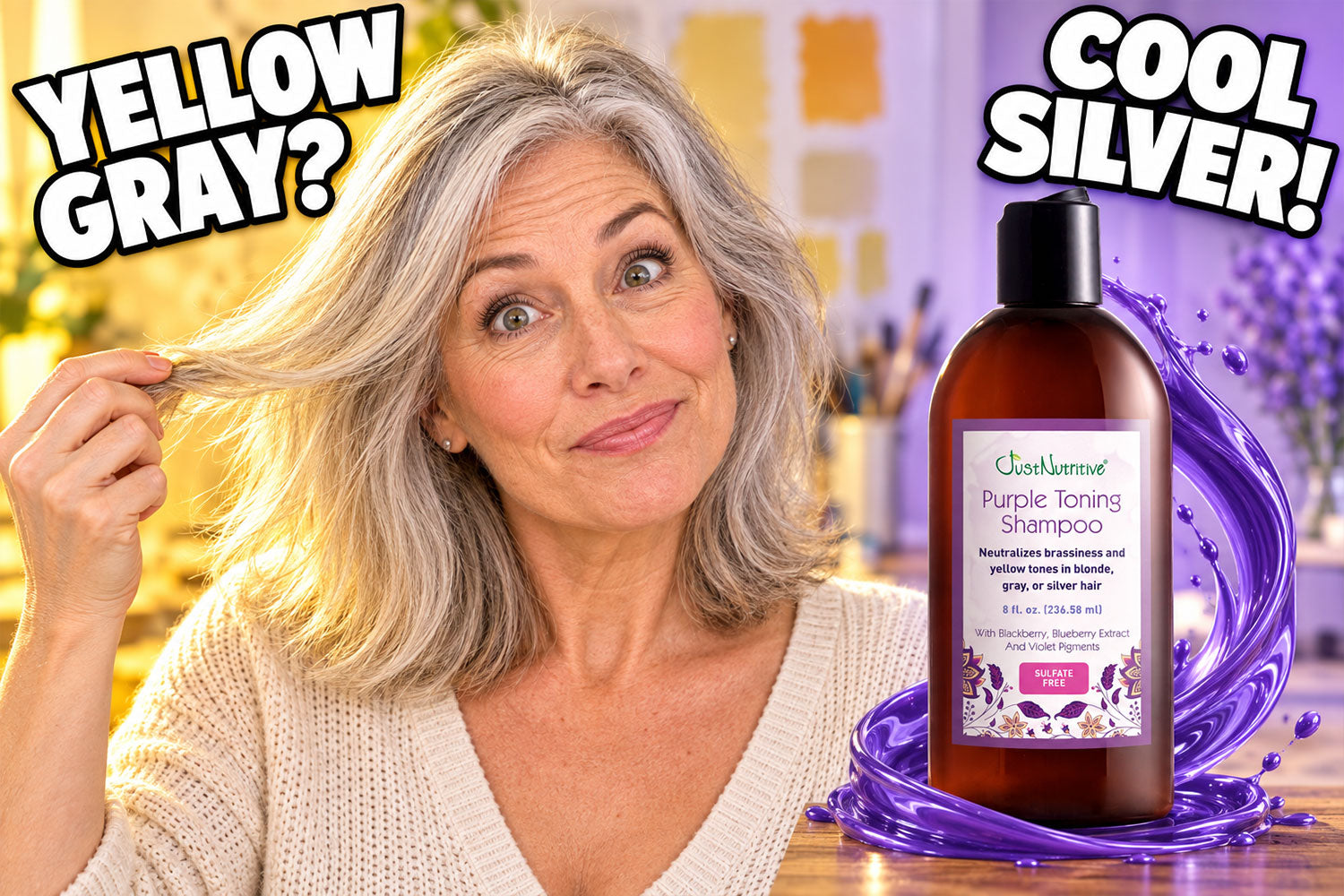
Violet pigment in a sulfate free, paraben free base built around aloe, blueberry, blackberry and pomegranate. No dyes or tints that change your base color. 8 oz, made in the USA.
Not a dye. A toner.
Purple shampoo does not change your base color. It deposits a violet tint that neutralizes the yellow and orange tones that show up in blonde, bleached, gray and white hair.
The violet comes from blueberry and blackberry extracts, blended with avocado oil, pomegranate seed oil and hydrolyzed rice protein so hair stays soft rather than stripped. Handmade in small batches, sulfate free and paraben free.
Swap it in for your regular shampoo once a week, or every few washes.
Usually because your hair is low porosity. Violet pigment binds to the outside of the cuticle, so it needs somewhere to grip. Virgin gray hair is tight, so pigment rinses away before it attaches. The fix is contact time.
Start at the labeled 5 to 10 minutes. If nothing changes after a few washes, extend to 15 or 20 on the resistant sections. If you are seeing lilac patches, cut to 2 or 3 minutes, or dilute it into your regular shampoo.
Because your roots and ends are different surfaces. Newer hair near the scalp is tighter and takes less pigment. Weathered ends are porous and grab more, so applying evenly gives an uneven result. Work the resistant sections first and add the ends last.
It does not damage the hair structure, but it often leaves it feeling drier, and that is real. Violet pigment is anionic and most conditioning agents are cationic, so the two cannot coexist in one bottle. Less conditioning is the trade. Always follow with a conditioner.
It can leave a lilac cast on porous hair if left too long, though it is temporary and clears within a wash or two. Clarifying shampoo speeds it up. Resistant hair almost never has this problem, which is the irony: the people who worry most get no deposit at all.
No, and this matters. It covers yellow, it does not remove the cause. Yellowing comes from heat, UV, hard water minerals, chlorine and buildup, and toning addresses none of them. If minerals are the problem, clarify first. Heat yellowing is generally permanent.
Purple shampoo has a narrower job than most people think. It lays violet pigment on the outside of the cuticle to cancel yellow visually, and that pigment needs a lifted, slightly porous surface to hold onto. Bleached hair gives it one. Natural gray hair, which is usually tighter and coarser, often does not.
That single fact explains both of the complaints you hear most. Nothing happens on resistant lengths, and too much happens on porous ends, which is why one bottle can leave you patchy in a single wash.
Which is also why the base matters. Leaving a harsh sulfate shampoo on coarse gray hair for twenty minutes will strip it, and that is part of why most bottles tell you three. A sulfate free formula is gentle enough to sit on your hair as long as the pigment actually needs.
Bethany Page
is a content writer and in-house ingredient researcher at Just Nutritive, where she studies the plant oils, botanicals and natural compounds that go into every formula. Her background in herbal medicine shapes how she reads a product: she starts with the ingredient list, not the marketing claim. She writes from the principle that the best ingredients are usually the simplest ones.