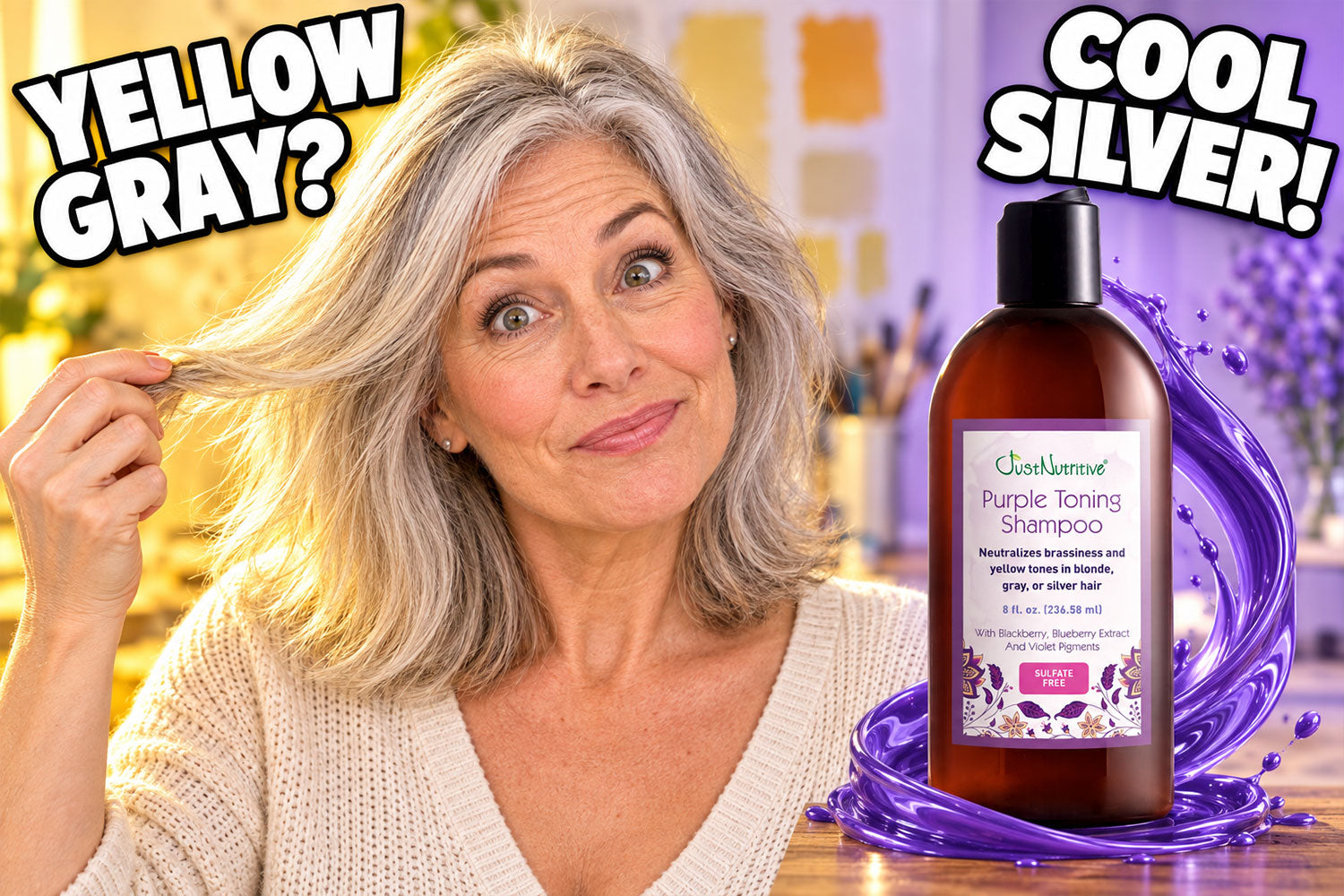
Is Purple Shampoo a Hair Dye? What It Actually Does to Your Hair
I have been using this once a week for about a month and the yellow is completely gone. My hair looks so much brighter and cleaner between salon visits." — Jessie M., verified customer
Purple shampoo is not a hair dye. It is a toning treatment that works on the surface of the hair to neutralize yellow and brassy tones without permanently changing your color.
If you have gray, silver, blonde, bleached, or white hair and have been wondering whether purple shampoo is safe, how it actually works, or whether it is right for you, this article answers all of it.
How the Just Nutritive Purple Shampoo Works
The Just Nutritive Purple Shampoo gets its violet pigment from blueberry and blackberry extracts rather than synthetic dyes. These natural anthocyanin compounds deposit onto the surface of the hair shaft to neutralize warm tones without penetrating like permanent color does.
The formula also contains avocado oil, pomegranate seed oil, hydrolyzed rice protein, and panthenol so it conditions while it tones. That matters because the hair types that need purple shampoo most are also the most vulnerable to drying out from frequent washing.
Free from sulfates, parabens, and synthetic fragrances. Handmade in the USA.
What Makes Purple Shampoo Different From Hair Dye
Hair dye works by opening the hair shaft and depositing permanent color molecules inside the cortex of each strand. That process changes your hair color at a structural level and does not wash out.
Purple shampoo works entirely differently. It deposits temporary violet pigment molecules onto the outside surface of the hair shaft. Those molecules sit on the cuticle, not inside it, and they wash away gradually with each shampoo.
The result is tone correction rather than color change. Your underlying hair color stays exactly the same. What shifts is the warmth or coolness of how that color reads to the eye. Yellow tones are neutralized by violet, which is directly opposite on the color wheel, leaving the hair looking brighter, cooler, and closer to its true tone.
The intensity varies depending on the individual, ranging from minimal notability to irritability. Most cases are mild, but in rare instances, redness and tenderness may occur. If experiencing any additional side effects, discontinue use and consult a medical professional. Please report any additional side effects to customer care.
"I was nervous it would turn my hair purple but it did not at all. I left it on for about five minutes and rinsed it out and my gray looked so much more silver than it has in years. I am obsessed." — Denise R., verified customer
Why Gray, Blonde, and White Hair Goes Brassy in the First Place
Understanding why brassiness happens makes it much easier to understand why purple shampoo works.
Gray and white hair contains no melanin to mask discoloration. That makes it highly susceptible to picking up yellow tones from mineral deposits in tap water, UV exposure, product residue, chlorine, and the natural oxidation that happens to all hair over time. Blonde and bleached hair faces the same vulnerability because the lightening process removes the pigment that would otherwise buffer these effects.
The result is hair that was once a clean silver, platinum, or ash blonde gradually shifting toward yellow, orange, or brassy. It is not damage in the traditional sense. It is a surface level accumulation of warm tones that cool toned hair simply cannot resist without help.
The Results


Ingredient References
Anthocyanins from Blueberry and Blackberry Extract (Natural Violet Pigment Source)
Study 1: Application of Anthocyanins from Blackcurrant Fruit Waste as Renewable Hair DyesJournal of Agricultural and Food Chemistry, PubMed, National Library of Medicine https://pubmed.ncbi.nlm.nih.gov/29808681/
Study 2: Structure and Function of Blueberry Anthocyanins: A Review of Recent AdvancesScienceDirect, 2021 https://www.sciencedirect.com/science/article/pii/S1756464621005132
FAQ
Can I use purple shampoo every time I wash my hair?
Using it every wash can cause over-toning, especially on very light or porous hair. Once or twice a week as a replacement for your regular shampoo is the right frequency for most hair types.
What if my hair already has a purple tint from a previous product?
Switch back to your regular shampoo for a few washes and the surface pigment will fade naturally. You can then reintroduce purple shampoo at a shorter processing time to avoid repeating the result.
Does purple shampoo work on natural gray hair or just color-treated hair?
It works on both. Natural gray and white hair often develops yellow tones from environmental exposure and mineral buildup just as color-treated hair does, and purple shampoo addresses both causes the same way.
Should I follow purple shampoo with a regular conditioner?
Yes, always. The Just Nutritive Purple Conditioner is formulated to pair with this shampoo and restores moisture without compromising the toning result. A moisturizing conditioner step after any toning shampoo is important for keeping light, porous hair in good condition.
Leave a comment
Also in Blogs

How to Find the Best Shampoo for Gray Hair (Without Going Purple)

Why Do My Arms Look Crepey? What Crepey Skin Needs