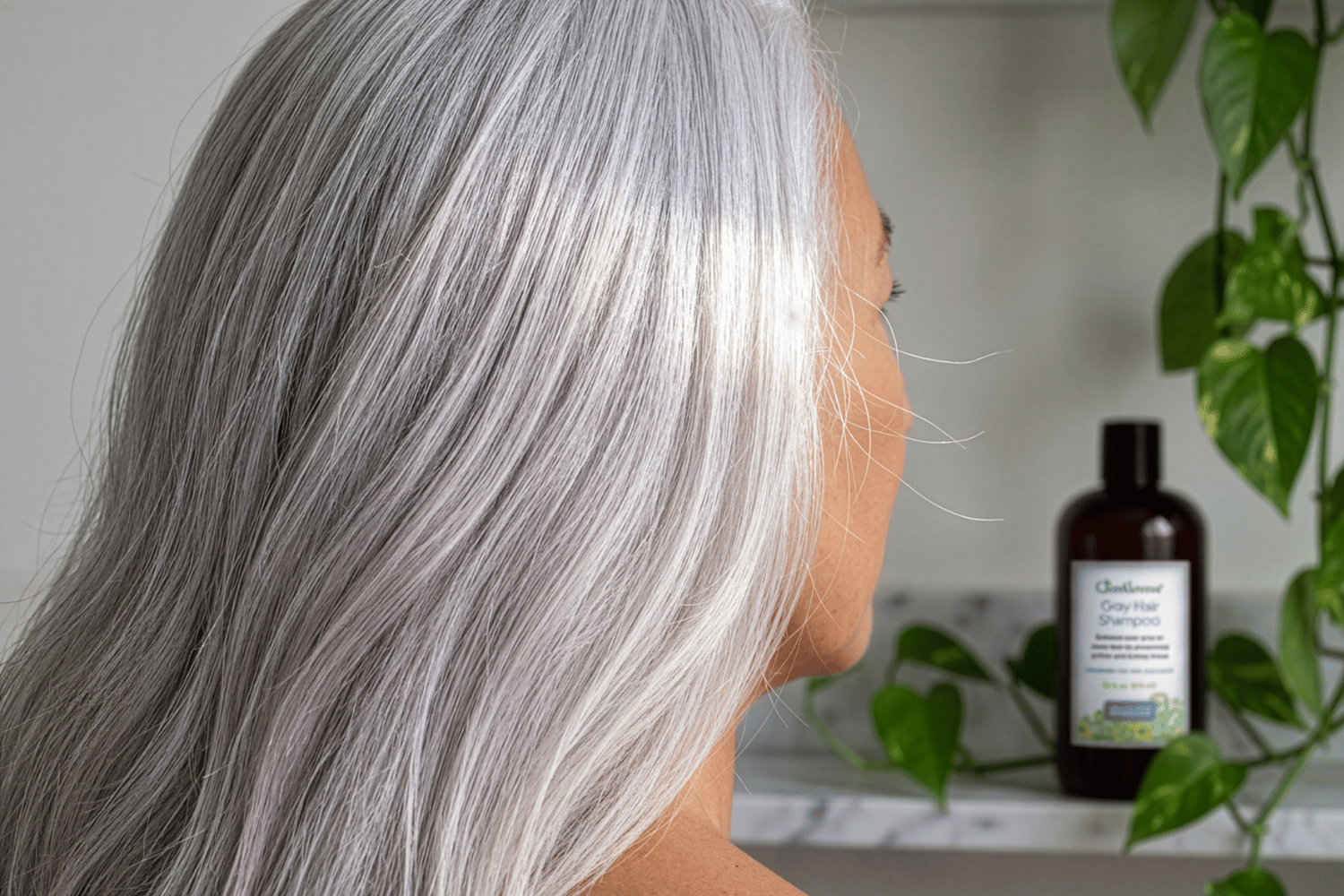
Why Gray Hair Needs a Sulfate Free Shampoo (and What Happens Without One)

Figuring out the right hair care routine for gray, silver, or transitioning hair can feel overwhelming, with so many products promising to fix dullness, dryness, and brassiness all at once. No worries, we are here to break down what actually works and why, starting with the ingredients that matter most.
Why you can trust us:
- We formulate every product by hand in the USA, using clean, transparent ingredient lists with no hidden chemicals
- Our Gray Hair Shampoo has earned Amazon's Choice status and over 1,100 verified customer reviews
- We are committed to cruelty free, vegan formulas built specifically around the needs of aging and gray hair
Table of Contents
Sulfates and Gray Hair: Why Sulfate Free Shampoo Matters
Somewhere around the time your hair starts going gray, your scalp and strands quietly change on a chemical level too. That means the shampoo that worked fine in your twenties might now be doing real damage every time you lather up, and sulfates are usually the main culprit. If you have noticed your gray hair feeling coarser, drier, or duller than it used to, the ingredient list on your shampoo bottle is a good place to start looking for answers.
What Sulfates Actually Do to Your Gray Hair
Sulfates like SLS and SLES are detergents. The same category used in dish soap.
They create that thick, foamy lather people associate with a "deep clean." Here's the mechanism:
- Sulfates break down the lipid bonds holding oil and dirt to your hair and scalp
- That works great on grease and buildup
- But sulfates can't tell the difference between excess oil and the natural sebum protecting your hair
The result: your scalp's protective oils get stripped right along with the dirt. The hair cuticle roughens. Moisture escapes faster. Hair tangles more and reflects less light, which is why over shampooed hair often looks flat no matter how much conditioner you use.

Why Gray Hair Is More Vulnerable to Sulfate Damage
Gray hair is not simply "hair without color." It's structurally different, and here's why.
Two things happen when melanin production slows:
- Follicles produce less sebum, so gray hair starts out drier than pigmented hair
- The hair shaft becomes coarser and more irregular, which is part of why gray hair often feels wiry
Now combine that with a sulfate stripping away what little moisture is left. Dryness leads to frizz. Frizz leads to more styling and heat. The cycle compounds fast.
This is exactly why so many people notice their gray hair improving almost immediately after switching to a gentler cleanser. They're not adding anything magical. They're just removing what was working against them.
There's a visual layer too: gray and white hair has less melanin to mask discoloration, so yellowing and dullness show up far more visibly than on pigmented hair.

Other Ingredients Worth Watching
Sulfates get most of the attention, but a few other ingredients are worth checking for:
❌ Parabens. Preservatives (methylparaben, propylparaben) linked to scalp irritation for some people. Many with sensitive, aging scalps choose to avoid them.
❌ Silicones. Give an instant silky feel by coating the strand, but that coating builds up over time and can trap dulling residue against gray hair specifically.
❌ Artificial dyes and synthetic fragrance. Common triggers for scalp irritation and redness, especially as skin grows more reactive with age.
What a Clean Ingredient List Actually Looks Like
It's one thing to say "avoid sulfates." It helps more to see what replaces them. Just Nutritive Gray Hair Shampoo was built around the two problems above: gray hair's dryness, and its tendency to look yellow or dull.
Instead of sulfates:
✅ Decyl Glucoside and Sodium Methyl Cocoyl Taurate, gentle, coconut derived cleansers that lift dirt without stripping the scalp's moisture barrier.
For moisture and strength:
✅ Avocado Oil, Pomegranate Seed Oil, and Blackcurrant Seed Oil replace the sebum gray hair naturally lacks
✅ Hydrolyzed Rice Protein and Panthenol (Vitamin B5) strengthen and soften the hair shaft
For brightness, without dye:
✅ Clover Flower Extract and Guava Fruit Extract help lift yellowing and brassy buildup naturally, no artificial pigment involved.
What's left out:
No parabens. No silicones. No artificial dyes. No synthetic fragrance.
How to Switch Without Overdoing It
A few habits make the switch to sulfate free shampoo more effective:
- Wash less often. One to two times a week is plenty for gray hair with a gentle formula
- Rinse with cool water. Helps the cuticle lie flat, locking in shine
- Pair it with a matching conditioner. Adds a layer of hydration a sulfate free shampoo alone won't fully cover
- Address hard water separately. A periodic clarifying or vinegar rinse handles mineral buildup that shampoo alone can't touch

Sulfate Shampoo vs. Sulfate Free Shampoo for Gray Hair
| Factor | Sulfate Based Shampoo | Sulfate Free Shampoo (like Just Nutritive) |
|---|---|---|
| Cleansing method | Strong detergents strip oil and dirt indiscriminately | Gentle, coconut derived cleansers remove dirt without stripping natural oils |
| Effect on moisture | Removes natural sebum, worsening dryness | Preserves moisture, supplemented with plant oils |
| Effect on cuticle | Roughens over time, increasing frizz | Supports a smoother cuticle and better shine |
| Color and yellowing | Can worsen dullness | Reduces yellowing with natural extracts, no dye |
| Common additives | Often paired with parabens, silicones, fragrance | Free from parabens, silicones, artificial dyes, and fragrance |
| Best for | Oily hair needing an occasional deep clean | Gray, silver, white, or aging hair prone to dryness |
Conclusion
Gray hair isn't high maintenance because something's wrong with it. It's high maintenance because most shampoos were never built with its chemistry in mind, and sulfates are usually where that mismatch starts.
Want to see a formula built the other way around? Just Nutritive Gray Hair Shampoo was designed specifically around the sulfate free, non purple approach covered above.

Is sulfate free shampoo really better for gray hair, or is it marketing?
It's a real difference, not just marketing. Sulfates strip oils gray hair is already low on. That said, "sulfate free" alone doesn't guarantee a good product, the rest of the ingredient list still matters.
Will switching to sulfate free shampoo make my hair feel dirty faster?
Not usually. Some people notice less of that "squeaky clean" feeling at first. Most adjust within a few washes, and many end up washing less overall.
Can I incorporate these poses into my daily routine?
Definitely! A daily practice, even if short, can offer immense benefits.
Can sulfate free shampoo fix yellow or brassy gray hair on its own?
It helps a lot, especially with brightening extracts like Clover Flower and Guava. But hard water yellowing is a separate issue best handled with a weekly clarifying or vinegar rinse.
How is a non purple, sulfate free shampoo different from purple shampoo?
Purple shampoo deposits violet pigment to cancel out yellow tones, but overuse risks a blue or purple tint. A non purple, sulfate free formula brightens through gentle cleansing and natural extracts instead, better suited to daily use.
How long until I notice a difference?
Softer, less frizzy hair often shows up within the first one to three washes. Bigger changes in shine and brassiness typically build over two to four weeks.
Sulfates strip natural oils from hair and scalp, and gray hair already produces less oil to begin with, making the damage more noticeable
Gray hair is structurally different: lower sebum production plus a coarser hair shaft means it dries out and frizzes faster than pigmented hair
Other ingredients to avoid include parabens, silicones, artificial dyes, and synthetic fragrance, all of which can worsen dryness or irritation over time
Sulfate free formulas (like Just Nutritive Gray Hair Shampoo) clean gently while preserving moisture, using natural extracts to reduce yellowing without dye

Author: Valeria
One of Just Nutritive's house expert and content writer, with a background in herbal medicine that shapes the way she thinks about skincare. She believes the best ingredients are often the simplest ones, and she spends her time researching the plant oils, botanicals, and natural compounds that go into every formula.
Related Readings


Leave a comment
Also in Blogs


How to Get Yellow Out of Gray Hair (and Keep It Bright)