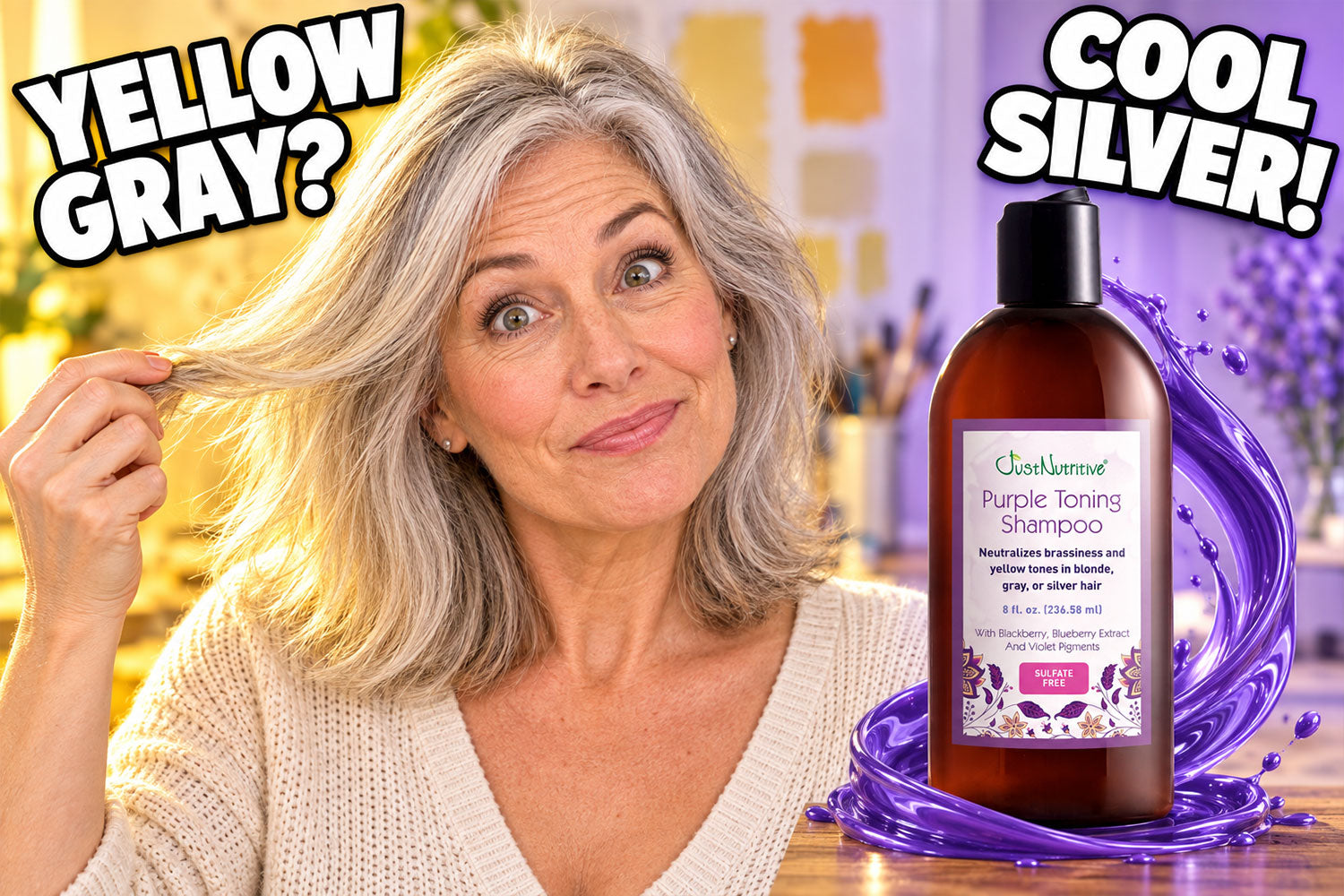
If you have blonde, gray, silver, or highlighted hair, chances are someone has told you to grab a purple shampoo the moment brassy yellow tones start creeping in. But right before you add one to your cart, a fair question deserves an honest answer: is purple shampoo bad for hair?
The short answer is that the product itself is not inherently harmful. The real issue is what many of these toning formulas are built with. Some are gentle enough for weekly use. Others are loaded with harsh sulfates, heavy synthetic dyes, and drying alcohols that can leave hair feeling straw like over time. In this guide, we will break down exactly how purple shampoo works, what actually causes damage, how to tell if your current formula is doing more harm than good, and what a truly gentle version should look like.
To understand whether this kind of toning shampoo can hurt your hair, it helps to understand what it is doing in the first place.
Purple shampoo relies on basic color theory. On the color wheel, purple sits directly opposite yellow. When you apply a violet tinted shampoo to hair that has warm, brassy, yellow, or orange undertones, the violet pigment neutralizes those unwanted tones. This is why it is so popular among people with blonde, bleached, gray, silver, and salt and pepper hair. All of these hair types are prone to picking up brassiness from things like UV exposure, hard water minerals, chlorine, and the natural breakdown of hair color over time.
Every purple shampoo, whether it is a budget drugstore option or a premium salon formula, works this same basic way. The pigment sits on the hair shaft, tones down yellow, and rinses away over several washes. What differs enormously from brand to brand is everything else in the bottle, and that is where the potential for damage comes in.
Purple shampoo is not automatically bad for your hair, but a lot of the shampoos marketed as purple toners are formulated in ways that can genuinely dry out, weaken, or discolor hair if you are not careful. Here are the three biggest culprits.
Many conventional purple shampoos use strong sulfate cleansers like Sodium Lauryl Sulfate to create that thick, foamy lather people associate with a deep clean. Sulfates are excellent at removing oil and buildup, but they are not selective. They also strip away the natural oils your scalp produces to keep hair soft, flexible, and protected. Used often enough, a sulfate heavy formula can leave color treated, bleached, or chemically processed hair feeling rough, dull, and more prone to breakage.
Because so many drugstore purple shampoos rely entirely on concentrated synthetic violet dye with nothing to balance it, it is easy to overdo it. Leave the formula on too long, or use it too frequently, and you can end up with a dull gray or faint lavender cast, especially on light blonde or white hair. This is not permanent, but it is a sign the shampoo is depositing more pigment than your hair actually needs
Purple shampoo is meant to be a targeted, occasional treatment, not a daily cleanser. Using a heavily pigmented, sulfate based formula every single day can lead to pigment buildup, scalp dryness, and hair that starts to look dull instead of bright. Most hair professionals recommend limiting this kind of toning wash to one or two sessions per week, adjusting based on how quickly your hair develops brassy tones.
If you are wondering whether your current bottle is part of the problem, watch for these warning signs.
None of these symptoms mean purple shampoo as a category is off limits. They usually point to a formula that relies too heavily on sulfates, synthetic fragrance, and concentrated dye with no conditioning agents to offset the toning process.
Even a well formulated one can cause problems if it is used incorrectly. Follow these steps to get the toning benefits without the downsides.
Not every purple shampoo is created equal, and the difference usually comes down to three things: the type of cleanser used, whether the formula includes real conditioning ingredients, and where the violet pigment actually comes from.
A gentler formula typically includes:
This is exactly the gap our Purple Shampoo at Just Nutritive was designed to fill. Instead of relying only on heavy synthetic violet dye and sulfate cleansers, our formula pairs a gentle, sulfate free cleansing base with natural anthocyanin pigments sourced from blueberry and blackberry extract. Anthocyanins are the same plant compounds responsible for the deep blue and violet colors found throughout nature, and they work alongside the formula's approved violet dye rather than replacing it entirely with a heavy synthetic load.
The Just Nutritive Purple Shampoo was formulated specifically for people who want brass neutralizing results without the trade off of dry, brittle, overprocessed feeling hair. Rather than stripping strands with harsh sulfates, it uses mild cleansers like Decyl Glucoside and Sodium Methyl Cocoyl Taurate, paired with Avocado Oil, Pomegranate Seed Oil, Chia Oil, and Hydrolyzed Rice Protein to hydrate hair while the violet pigments go to work on brassiness.
Because the formula leans on natural anthocyanin pigments from blueberry and blackberry extract in addition to a small, cosmetically approved amount of violet dye, it is easier to control the toning intensity and less likely to leave hair with an unwanted ashy or blue cast when used as directed. It is also free of parabens, sulfates, and synthetic fragrance, which matters if your scalp tends to react to strong cleansers or heavily perfumed products.
For best results, follow the shampoo with a moisturizing purple conditioner and limit use to once or twice weekly, the same routine recommended for any purple toning product, gentle or not.
Purple shampoo is not bad for hair by design
It becomes a problem when the formula relies on harsh sulfates, heavy synthetic dye with no conditioning support, or when it is used to too often or left on too long
The safest approach is a formula built with gentle cleansers and real conditioning ingredients
Use it once or twice a week, and always follow up with a hydrating conditioner
A well made version, like the naturally pigmented formula from Just Nutritive, can neutralize brassiness while actually supporting healthier, softer hair rather than working against it
It can, but usually only when the formula uses harsh sulfate cleansers, heavy synthetic dye, or when it is used more often than recommended. Choosing a gentle, sulfate free formula and limiting use to once or twice a week greatly reduces this risk.
Most people get the best results using it once or twice a week. Daily use is rarely necessary and increases the chance of dryness, pigment buildup, or an unwanted ashy tint.
Not when used correctly. A properly formulated one deposits just enough violet pigment to cancel out yellow and orange tones. Leaving it on far longer than recommended, or using it daily, is usually what causes a visible purple or gray cast.
Yes, and gray or silver hair is actually one of the categories that benefits most from it. Gray hair is especially prone to picking up yellow tones from hard water minerals and UV exposure, and a gentle toning formula helps restore that bright, cool, silver looking finish.
Look for a formula free of sulfates and parabens, one that includes real conditioning oils or proteins, and ideally one that uses natural pigment sources alongside its violet dye rather than relying on a heavy synthetic load alone.
So, is purple shampoo bad for hair? Not inherently, but the wrong formula absolutely can be. If your current formula is leaving your hair feeling dry, brittle, or oddly tinted, it is worth switching to a gentler option built with real conditioning ingredients and natural pigment sources. Our Purple Shampoo was made to neutralize brassiness the way it should, without sacrificing the health and softness of your hair along the way.
Author: Valeria
One of Just Nutritive's house expert and content writer, with a background in herbal medicine that shapes the way she thinks about skin hair care. She believes the best ingredients are often the simplest ones, and she spends her time researching the plant oils, botanicals, and natural compounds that go into every formula.