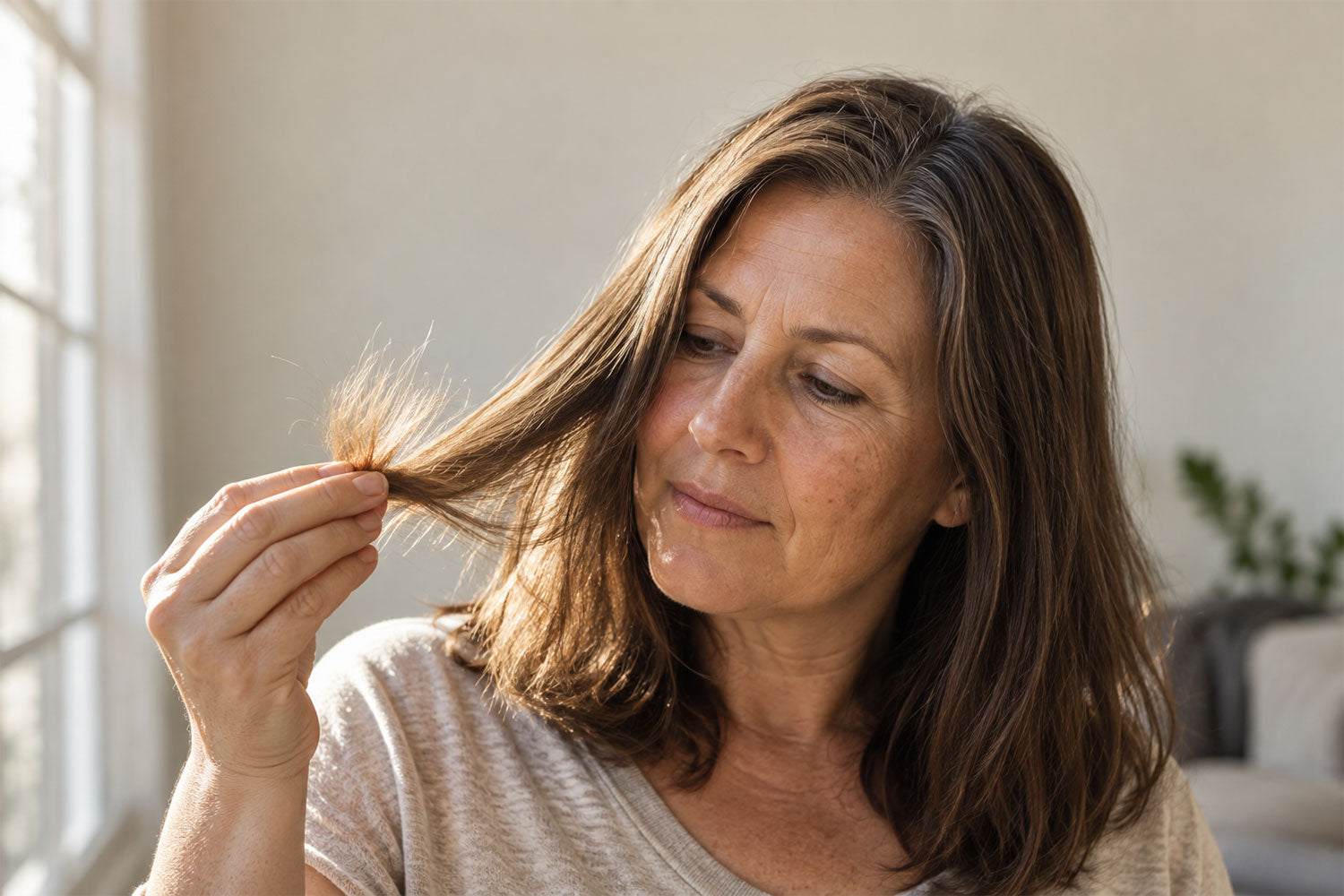
You are not imagining it. Somewhere in your late thirties or forties, your hair starts to behave differently. It may feel thinner at the part. Your ponytail may feel lighter. The volume you used to have just does not bounce back the way it once did.
This is a real shift and it happens to most women. The good news is that understanding why it happens makes it much easier to know what to do about it.
Hormones are the main driver. As estrogen levels shift during perimenopause and menopause, hair follicles shrink and the growth phase of each hair shortens.
The result is hair that grows more slowly, sheds a little more than before, and does not build up the density it used to.
This is not hair loss in the dramatic sense. For most women it is a gradual thinning that shows up first at the part line or in a ponytail that feels lighter than it used to. Stress, nutrition, and genetics all play a role too. But for women in their forties and fifties, hormonal change is almost always part of the picture.
At this stage your hair needs two things more than anything else. Scalp circulation support and strand strength.
Poor circulation to the scalp means follicles receive fewer nutrients. That slows growth and weakens the hair that does grow. Scalp health matters more in your forties than it ever did in your twenties, and most women have never thought about it at all.
Strand strength matters because thinner hair breaks more easily. When hair is breaking at the same rate it is growing, length and density stay flat no matter what you try. Protecting what you have is just as important as encouraging what grows.
Most styling products ask you to choose between hold and health. The Just Nutritive Herbal Gel with Essences does not ask you to make that trade.
It offers a soft to medium flexible hold that keeps hair in place without stiffness or crunch. More importantly it delivers a daily dose of ingredients specifically chosen to support scalp circulation and strand resilience while you style.
Rosemary leaf oil supports blood flow to the scalp. Panthenol, the form of Pro-Vitamin B5 used in this formula, nourishes each strand and helps support the follicle cells responsible for the growth phase. Kukui nut oil and buriti fruit oil add essential nutrients to the scalp. Aloe vera and cranberry seed oil hydrate and smooth from root to end.
It works on damp or dry hair. It is free from alcohol, parabens, artificial fragrances, and artificial coloring. One product that fits into the routine you already have.
Women who use the Just Nutritive Herbal Gel with Essences consistently tend to notice manageability first. Hair that felt dry or unruly after washing begins to feel softer and easier to work with from the first use.
Over several weeks of daily use the changes that matter more start to show. Hair feels less like it is breaking at the ends. The part line looks a little fuller. Styling takes less effort because the hair itself is in better condition.
Women who have been dealing with gradual thinning describe it as a product that works quietly in the background. It does not make dramatic promises. It just shows up every day and does something useful for the hair you are trying to protect and grow.
Rosemary Leaf Oil has become one of the more studied natural ingredients for scalp and hair health. A randomized comparative trial published in PubMed found that rosemary oil produced a significant increase in hair count at the six month mark, with results comparable to minoxidil 2% without the scalp itching that minoxidil commonly causes. The research is promising and honest. It takes time and consistency to see results, which is true of any ingredient that works at the follicle level.
Panthenol (Pro-Vitamin B5) has a more direct body of research behind it. A study published in PMC examined the effects of D-panthenol on human hair follicle cells and found that it enhanced cell viability, reduced markers of cell aging in follicles, and stimulated the growth factors associated with the anagen, or active growth, phase of the hair cycle. For women whose follicles are naturally slowing with age, that kind of support at the cellular level matters.
Rosemary Leaf Oil
Study 1: Rosemary Oil vs Minoxidil 2% for the Treatment of Androgenetic Alopecia: A Randomized Comparative TrialPubMed, National Library of Medicine https://pubmed.ncbi.nlm.nih.gov/25842469/
Panthenol (Pro-Vitamin B5)
Study 1: Dexpanthenol Promotes Cell Growth by Preventing Cell Senescence and Apoptosis in Cultured Human Hair Follicle CellsPMC, National Institutes of Health, 2021 https://pmc.ncbi.nlm.nih.gov/articles/PMC8929036/